

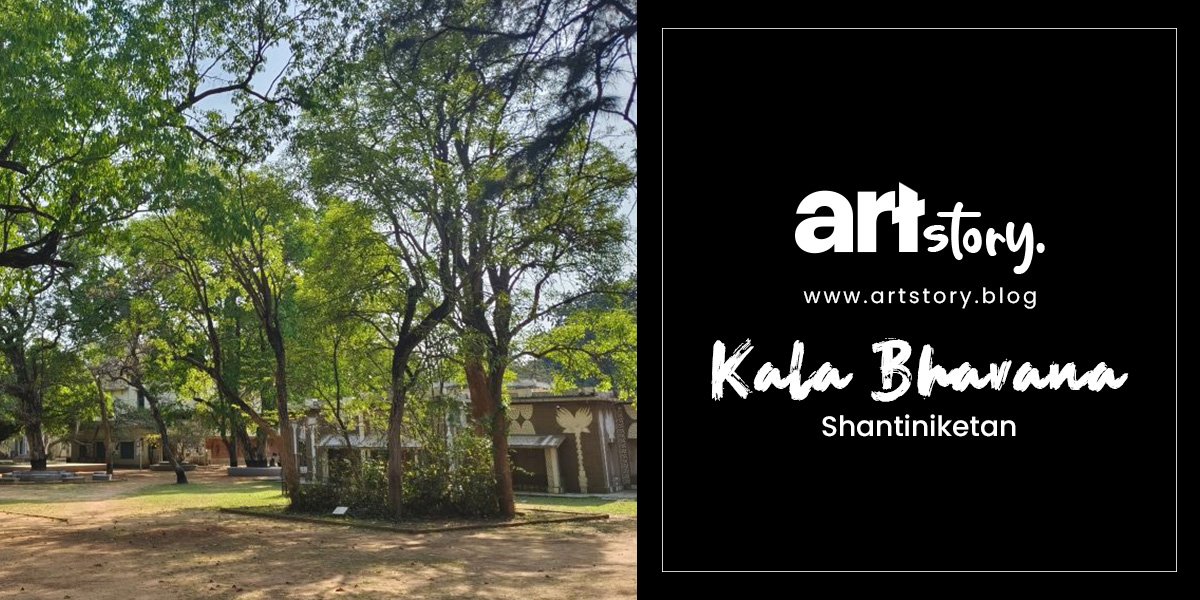
Imagine an art college that has no closed classrooms, no strict British uniforms, and no bells ringing to change periods. Instead, the students sit under the shade of massive mango trees. The sweet smell of wet earth is in the air, a tribal Santhal woman is walking by with a basket, and the students are happily painting exactly what they see.
This is not a dream. This is Kala Bhavana, the fine arts faculty of Visva-Bharati University in Shantiniketan.
If the Government College of Art in Calcutta was the birthplace of modern Indian art, Kala Bhavana is where Indian art truly found its freedom. Started by the great poet Rabindranath Tagore, this institution completely changed how art was taught in India.
Welcome back to artstory.blog. Today, let’s take a beautiful journey to the red soil (Lal Mati) of Birbhum to understand the history, the masters, and the masterpieces of India’s most spiritually rich art college.
Chapter 1: The Vision of Gurudev (How It All Began)
In the early 1900s, art schools in India (which were controlled by the British) were very strict. Students were locked inside dark rooms to copy European statues.
Gurudev Rabindranath Tagore hated this idea. He believed that art cannot be created inside a cage. He believed that nature is the greatest teacher. So, in 1919, he established Kala Bhavana in his experimental town of Shantiniketan (which means ‘The Abode of Peace’).
Rabindranath Tagore’s rule was simple: Art must be connected to daily life and nature.
He wanted his students to look at the trees, the local animals, and the rural people living around them. He also wanted Kala Bhavana to be a place where the whole world could meet. So, he invited artists from Japan, China, and Europe to come and teach alongside Indian masters. It became a beautiful melting pot of global and Indian culture.
Chapter 2: The Arrival of “Master Moshai” (Nandalal Bose)
Rabindranath Tagore knew that to run an art college, he needed a genius. So, he invited Nandalal Bose—the star student of Abanindranath Tagore—to come and take charge.
In 1922, Nandalal Bose became the principal of Kala Bhavana. Everyone respectfully called him Master Moshai.
Under Nandalal’s guidance, Kala Bhavana blossomed. He told his students to stop buying expensive foreign paints. Instead, he taught them to make colors from local leaves, flowers, and the red earth of Shantiniketan. He encouraged them to learn traditional Indian crafts like weaving, pottery, and block-printing (Batik), proving that making a beautiful clay pot was just as important as painting a grand picture.
Chapter 3: The Holy Trinity of Kala Bhavana
To truly understand Kala Bhavana, you have to know about the three legendary teachers who built its soul. In the art world, they are often called the “Trinity of Shantiniketan”:
1. Nandalal Bose: The calm, disciplined leader. He brought the classical Indian styles, the Japanese wash techniques, and the Swadeshi spirit to the college.
2. Benode Behari Mukherjee: He was a student who later became a teacher here. Benode Behari had very weak eyesight since childhood, and eventually, he went completely blind. But his inner vision was so strong that he painted some of the most massive and brilliant murals (wall paintings) in Indian history! He showed that true art comes from the mind, not just the eyes.
3. Ramkinkar Baij: If Nandalal was calm, Ramkinkar was a wild storm. Coming from a very poor village family, Ramkinkar was a rebel. He did not care about neat and clean paintings. He looked at the local Santhal tribal people and made giant, rough, powerful sculptures out of cheap cement and pebbles. He is considered the father of modern Indian sculpture.
Chapter 4: An Open-Air Museum (Masterpieces on the Campus)
The most amazing thing about Kala Bhavana is that its greatest artworks are not locked inside glass boxes. They are outside, in the sun and rain, becoming a part of nature.
Here are the iconic masterpieces you will see if you walk around the campus today:
1. The Santhal Family (Sculpture by Ramkinkar Baij)
- The Story: Created in 1938, this massive sculpture sits right in the open. It shows a Santhal tribal family moving to a new place to find work. The man is carrying baskets, the woman is walking beside him with a baby, and a stray dog is trotting along.
- Why it is special: Before this, statues in India were only made for kings, British officers, or gods, and they were made of expensive marble or bronze. Ramkinkar made a monument for the poorest, hardest-working people of India, and he made it using cheap cement and laterite pebbles from the local soil. It is rough, raw, and incredibly powerful.
2. Life of Medieval Saints (Mural by Benode Behari Mukherjee)
- The Story: This is a gigantic painting that covers the upper walls inside the Hindi Bhavana building at Shantiniketan. It was painted by Benode Behari Mukherjee in 1947.
- Why it is special: It tells the story of India’s great Bhakti movement saints, like Kabir, Tulsidas, and Surdas. The scale of this painting is mind-blowing. What makes it a true masterpiece is that Benode Behari painted this massive wall when he was almost completely blind! He used a wet-fresco technique, climbing high ladders, completely guided by his memory and inner feeling.
3. The Kalo Bari (Black House)
- The Story: Kala Bhavana has a unique hostel building called Kalo Bari. It is made entirely of mud and coal-tar (which gives it a shiny black look).
- Why it is special: The walls of this building were decorated by Nandalal Bose, Ramkinkar Baij, and their students. They created amazing relief sculptures (raised art) on the mud walls, showing mythological stories, animals, and village life. It proves Rabindranath Tagore’s idea that art and daily living spaces should be merged into one.
Chapter 5: Festivals as Art (The Spirit of Nandan Mela)
At Kala Bhavana, art is not just homework; it is a celebration. Rabindranath and Nandalal started traditions that are still alive today.
During festivals like Basanta Utsav (Holi) and Poush Mela, the entire campus becomes an art gallery. The students decorate the roads and floors with breathtaking, massive Alponas (traditional Bengali floor art using white rice paste).
Today, every year on Nandalal Bose’s birthday (December 1st or 2nd), the college organizes the Nandan Mela. The students and teachers set up stalls to sell their own paintings, pottery, calendars, and crafts at very low prices. It is a time when the gap between the “great artist” and the “common public” completely disappears.
Conclusion
Kala Bhavana is not just an art college; it is an emotion.
While the British art schools in Calcutta and Mumbai taught Indians how to draw the human body perfectly, Kala Bhavana taught Indians how to draw the human soul. It taught us that art lives in the red dirt of Birbhum, in the sweat of the Santhal farmer, in the falling autumn leaves, and in the joy of village festivals.
If you are an art lover, a visit to the Kala Bhavana campus in Shantiniketan is like a pilgrimage. It is the place where modern Indian art found its home under the open sky.