

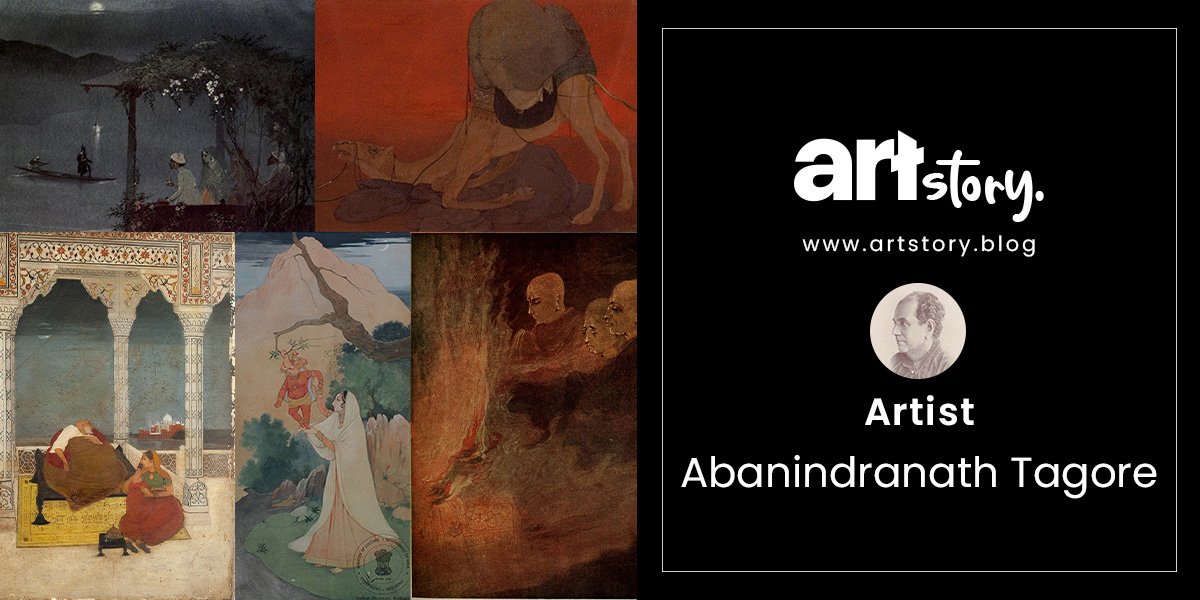
If you walk into any major art gallery in India today, you will see a huge variety of styles. But a little over a hundred years ago, Indian art was going through a major identity crisis. While British rulers were teaching young Indians to paint exactly like Europeans, and artists like Raja Ravi Varma were mastering Western oil painting, one man stopped and asked a very important question:
“Why are we painting Indian stories using a European voice?”
He believed that Indian art was losing its spiritual touch. A photograph can capture the exact look of a person, but true Indian art was supposed to capture the soul.
That man was Abanindranath Tagore, the founder of the famous “Bengal School of Art.” He completely rejected Western realism and gave India its first modern, homegrown art movement.
Welcome to this deep-dive on artstory.blog. Today, we are going to explore the fascinating life of Abanindranath Tagore, his historic role in shaping India’s greatest art colleges, and the magical paintings that changed our visual history forever.
Chapter 1: The Boy from Jorasanko (Early Life)
Abanindranath Tagore was born on August 7, 1871, in the grand Jorasanko Thakur Bari in Calcutta (Kolkata). If the last name sounds familiar, it is because he belonged to the legendary Tagore family. He was the nephew of the great poet and Nobel laureate, Rabindranath Tagore.
Growing up in the Jorasanko mansion, young Aban (as he was fondly called) was surrounded by music, literature, theatre, and deep philosophical discussions. Creativity was simply a part of his everyday life.
Interestingly, Abanindranath’s art journey started the Western way. In the 1880s, he joined the Sanskrit College and later took private lessons from European artists like O. Ghilardi and Charles Palmer. They taught him exactly what was popular at the time: how to use thick oil paints, how to draw perfect human anatomy, and how to create realistic shadows.
He became very good at it, but something inside him felt empty. He felt that Western art was too materialistic. It was beautiful on the outside, but it lacked the inner emotion and spirituality that Indian culture was known for.
Chapter 2: The Swadeshi Awakening and the “Wash” Technique
During the late 1890s and early 1900s, the Swadeshi movement was growing in Bengal. Indians were starting to reject British clothes, goods, and educational systems. Abanindranath decided it was time to do the same with art.
He started studying the ancient, forgotten arts of his own country. He looked deeply into Mughal miniature paintings, the vibrant colors of Rajput art, and the breathtaking ancient murals inside the Ajanta Caves.
At around the same time, he met a Japanese art scholar named Okakura Kakuzo and Japanese painters like Taikan. From them, he learned the traditional Japanese “wash technique.” This was a method where watercolors were applied and then gently washed over with water again and again.
Abanindranath did something brilliant. He mixed the fine details of Mughal miniatures with the soft, blurry, dream-like Japanese wash technique. The result was pure magic. His paintings did not have the harsh lines or bright, shiny lighting of oil paintings. Instead, they looked like soft memories or mist—deeply emotional, delicate, and deeply Indian.
Chapter 3: Shaping the Great Art Colleges of India
Abanindranath’s impact was not just in his paintings; it was in how he taught the next generation.
At that time, an Englishman named E.B. Havell was the principal of the Government College of Art and Craft Calcutta. Unlike other British officers, Havell actually loved traditional Indian art and hated the fact that the college was only teaching European styles.
Havell met Abanindranath, saw his genius, and immediately appointed him as the Vice-Principal of the Government College of Art and Craft Calcutta. Together, they threw out the European statues used for practice and brought in Indian sculptures and Mughal paintings. This was a massive revolution! It was here that Abanindranath officially formed the “Bengal School of Art.”
He became a guru to a group of brilliant young students. He told them not to just copy nature, but to paint what they felt in their hearts.
One of his most talented students was Nandalal Bose. Carrying his guru’s vision forward, Nandalal Bose later went on to become the principal of Kala Bhavana Shantiniketan, turning it into one of the most highly respected and spiritually rooted fine art colleges in Indian history. The artistic link from Abanindranath at the Calcutta Art College straight to Shantiniketan is the very backbone of modern Indian art education.
Chapter 4: A Deep Dive into His Masterpieces
Let us look at some of Abanindranath Tagore’s most legendary paintings. Each one tells a story not just through its subject, but through its mood.
1. Bharat Mata (Mother India) – 1905
- The Story: Painted right in the middle of the partition of Bengal (1905), this is his most iconic work. Before this painting, Indians did not have a visual image of their country to pray to. Abanindranath gave the freedom struggle a face.
- Detailed Breakdown: Unlike the fierce warrior goddesses we see sometimes, this Mother India is incredibly peaceful, wearing a saffron sari like a sadhvi (saint). She has four arms. In them, she holds a book (representing education/Shiksha), a piece of white cloth (clothing/Diksha), sheaves of paddy (food/Anna), and a rudraksha mala (spiritual salvation/Dharma).
- Why it is great: It was the ultimate Swadeshi poster. Sister Nivedita, the famous disciple of Swami Vivekananda, was so moved by this painting that she wanted to print thousands of copies and distribute them to every village in India to inspire patriotism.
2. The Passing of Shah Jahan – 1902
- The Story: This heartbreaking painting captures the final moments of the great Mughal Emperor Shah Jahan. He was imprisoned in the Agra Fort by his own son, Aurangzeb. In his last moments, his loyal daughter Jahanara sits at his feet, as he looks out into the night.
- Detailed Breakdown: The painting is quite small, like a traditional miniature, but it holds massive grief. Abanindranath used very dark, muddy shadows for the room inside the prison. But outside the small window, the Taj Mahal is glowing in the pure white moonlight.
- Why it is great: It captures human tragedy perfectly. It shows a man who once ruled the wealthiest empire in the world, now dying as a prisoner, with his only comfort being the distant view of the monument he built for his true love.
3. Journey’s End – 1913
- The Story: On the surface, this is just a painting of an exhausted camel falling down in the desert. But it is filled with heavy symbolism.
- Detailed Breakdown: This is perhaps the finest example of his watercolor “wash” technique. The background is a dusty, blazing red—creating the intense heat of a desert evening. The camel has finally collapsed under the massive weight of the baggage tied to its back. Its eyes are half-closed, accepting the end.
- Why it is great: Many art critics believe this painting is a metaphor. Some say the camel represents the Indian society, completely exhausted and crushed under the heavy load of British colonial rule. Others say it simply represents the end of a long, difficult human life. You cannot look at this painting without feeling a deep sense of sympathy.
4. Ganesh Janani (Mother of Ganesha)
- The Story: This depicts Goddess Parvati spending a quiet, playful moment with her elephant-headed son, Ganesha.
- Detailed Breakdown: Abanindranath completely removed the “godly” distance from this painting. There are no heavy golden crowns or blinding halos. Parvati looks like a very normal, loving Indian village mother wearing a simple sari. She is leaning in, completely absorbed in her child. The edges of the figures are blurry, making it look like a sweet, old memory.
- Why it is great: It brought divinity down to the level of pure human love. It showed that the bond between a mother and child is the most sacred thing in the world, even for the gods.
5. Asoka’s Queen (Tishyarakshita)
- The Story: Tishyarakshita was the young, favorite queen of the great Mauryan Emperor Ashoka in his later years. History says she was jealous of Ashoka’s devotion to the Bodhi Tree (under which Buddha attained enlightenment).
- Detailed Breakdown: Look at the expression on her face. Abanindranath was a master of painting psychology. Her face is beautiful but carries a dark, brooding, and plotting look. The jewelry and the rich clothes are painted with miniature-like precision, but the mood is completely dark.
- Why it is great: It proves that Abanindranath could paint not just peaceful, holy figures, but also complex, flawed, and politically ambitious historical characters.
Chapter 5: The Writer and the Grandfather of Art
Many people don’t know this, but Abanindranath Tagore was also a phenomenal writer! Just as he created a new style of painting, he wrote wonderful books for children in Bengali.
Books like Budo Angla, Khirer Putul, and Rajkahini are still considered classics of Bengali literature. He used a very simple, spoken style of Bengali that connected instantly with children, just like his paintings connected with the Indian soul.
In his later years, his eyesight began to fail. He stopped painting large wash watercolors and started creating small toys and sculptures out of discarded tree branches, roots, and twigs. He called them Katum Kutum. Even when his eyes were weak, the artist inside him never stopped creating. Abanindranath passed away on December 5, 1951.
Conclusion
Abanindranath Tagore did not just paint pictures; he rescued India’s self-respect.
At a time when Indians were being told that their culture was backward, he stood up and proved that our ancient arts were highly evolved and spiritually superior. By blending Mughal, Rajput, and Asian techniques, and by inspiring the curriculums of great colleges like the Government College of Art and Kala Bhavana, he built the foundation of modern Indian art.
Next time you look at a beautiful, soft, watercolor painting of rural India or an Indian god, remember Abanindranath Tagore. He is the reason Indian art still has its soul. visionary who painted not just with colors, but with national pride.