

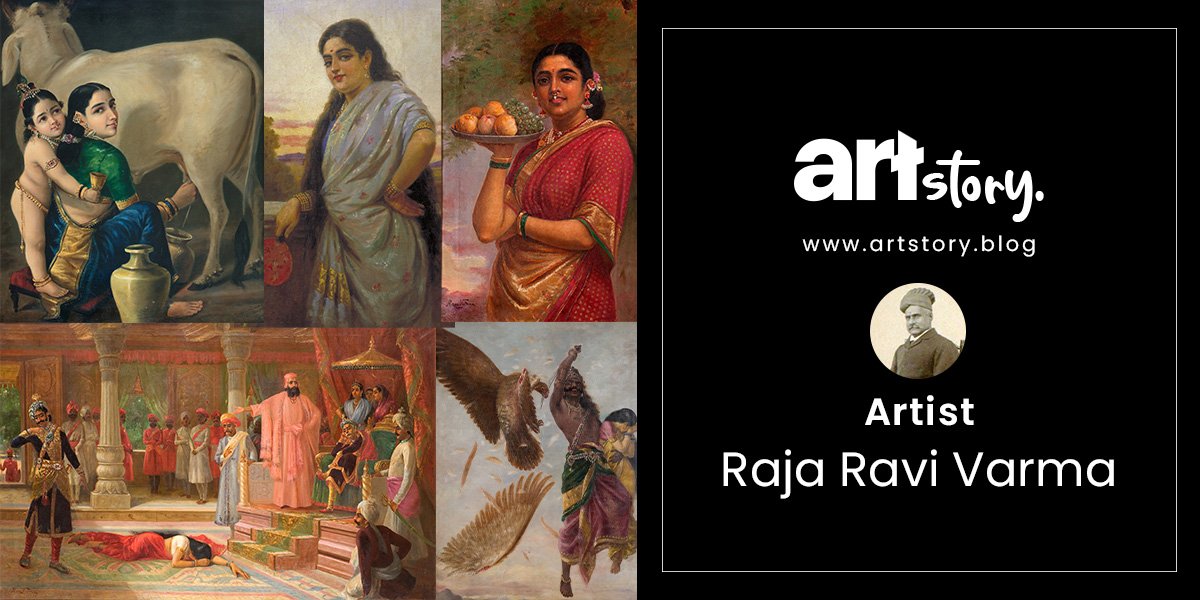
When we close our eyes and pray to Goddess Saraswati, we see a beautiful woman in a white sari, sitting peacefully by the water, playing the Veena. When we think of Goddess Lakshmi, we imagine her standing gracefully on a blooming lotus, dressed in a red silk sari, showering gold coins.
But have you ever stopped to wonder—who gave these specific faces and forms to our gods?
Before the late 1800s, paintings of gods in India looked very different. They were painted in traditional styles like Tanjore or Rajput miniature art. They were beautiful, but they looked flat (2D) and were not very realistic. Then came a man who changed Indian art forever. He painted Indian gods, kings, and common people looking like real, living, breathing humans.
That man was Raja Ravi Varma.
Welcome to this deep-dive on artstory.blog. Today, we will explore the magical, struggling, and glorious life of Raja Ravi Varma, and look closely at the magnificent paintings that made him the greatest artist in Indian history.
Chapter 1: The Boy Who Drew on Walls (Early Life)
Raja Ravi Varma was born on April 29, 1848, in a place called Kilimanoor, a beautiful, lush green village in Kerala. He came from an aristocratic family that had close ties with the royal family of Travancore.
Like many great artists, his journey started in his childhood home. Young Ravi Varma was obsessed with drawing. He would take pieces of charcoal and draw pictures of animals, trees, and people on the clean white walls of his house. Most parents would scold a child for spoiling the walls, but his uncle, Raja Raja Varma, noticed something special.
His uncle was a traditional artist himself. He saw that the boy’s drawings were not just random scratches; they had perfect shapes and life in them. To support his talent, his uncle took him to the royal palace in Thiruvananthapuram (Trivandrum) to get proper training.
This was the turning point of his life. At the palace, the young boy was exposed to beautiful classic paintings, royal patrons, and a world of art he had never seen before.
Chapter 2: The Struggle to Learn Oil Painting
In the royal palace, Ravi Varma learned the traditional styles, but he was hungry for more. During that time, European painters often visited the Indian royal courts to paint portraits of the kings.
Ravi Varma watched them in awe. The Europeans used a completely different medium: Oil Paints. Oil paints allowed artists to create shadows, light, and real-life skin tones. This technique was called “Realism.” Ravi Varma desperately wanted to learn how to use oil paints, but it was not easy.
At first, he asked a local palace painter named Ramaswamy Naidu, who knew oil painting, to teach him. But Naidu was jealous of Ravi Varma’s natural talent and flatly refused to teach him the secret techniques.
Did Ravi Varma give up? No.
Later, a Dutch painter named Theodor Jenson visited the court. Jenson also refused to take Ravi Varma as a direct student, but he allowed the young Indian artist to sit in the corner of the room and watch him paint. Ravi Varma watched carefully. He observed how the colors were mixed, how the brush touched the canvas, and how shadows were created.
Through pure observation, trial, and error, Raja Ravi Varma taught himself the European style of oil painting.
Chapter 3: Mixing Two Worlds (His Unique Style)
Raja Ravi Varma did something nobody else had done before. He took the Western technique of realism (using oil paints, perfect human anatomy, light, and shadow) and combined it with Indian soul and subjects.
Instead of painting European landscapes or foreign kings, he decided to paint what he loved:
- The great Indian epics: the Mahabharata and the Ramayana.
- The ancient Puranas and the stories of Hindu Gods.
- The beautiful, diverse women of India.
Before him, if you wanted to see a painting of Lord Krishna or Rama, it looked almost cartoon-like or symbolic. Ravi Varma painted them to look like real, muscular men with perfect expressions of anger, love, or sadness. He brought the gods down from the heavens and made them look like people we could relate to.
Chapter 4: Traveling Across India and the Story of the Sari
As he became famous, Ravi Varma received invitations from royal families all over India—from Mysore to Baroda (Gujarat). He travelled extensively by train.
During these travels, he observed the different ways Indian women dressed, the jewelry they wore, and the colors of their clothing. He was especially fascinated by the sari. In fact, many fashion historians say that Raja Ravi Varma popularized the modern way women wear the sari today (the “Nivi” drape). By painting goddesses and beautiful women wearing the sari in this specific draped style, he made it a national fashion standard!
Chapter 5: A Deep Dive into His Masterpieces
Let us look at some of his most brilliant and iconic paintings. Each one is a masterclass in detail and storytelling.
1. Shakuntala Looking Back (Shakuntala Patra Lekhan)
- The Story: This is taken directly from Kalidasa’s famous play, Abhijnanashakuntalam. The painting captures the exact moment Shakuntala is leaving the forest with her friends. She has fallen deeply in love with King Dushyanta. Not wanting to leave without looking at him one last time, she pretends that a sharp thorn has pierced her foot.
- Detailed Breakdown: Look at the way she is twisting her body. It is natural and graceful. The expressions of her friends are priceless—they know exactly what she is doing and have a slight, teasing smile on their faces. The background is a dense, realistic forest that creates a beautiful contrast with the bright red of Shakuntala’s clothing.
- Why it is great: It perfectly captures the emotion of new, shy love. It feels like a paused scene from a romantic movie.
2. Hamsa Damayanti
- The Story: From the Mahabharata, this is the love story of King Nala and Princess Damayanti. Since they lived far apart, a magical royal swan (Hamsa) acted as their messenger. In this painting, the swan is telling Damayanti about how handsome and brave King Nala is.
- Detailed Breakdown: This painting is famous for its texture. Notice the gold border (zari) on Damayanti’s sari—it shines as if real gold thread was used. Her face is glowing, tilted slightly downwards as she listens to the swan with a mixture of shyness and deep interest. The feathers of the swan look soft and real enough to touch.
- Why it is great: It shows Ravi Varma’s absolute mastery over oil paints. He made fabric look like real fabric, and skin look like real skin.
3. Jatayu Vadham (The Death of Jatayu)
- The Story: A heartbreaking scene from the Ramayana. The demon king Ravana has kidnapped Goddess Sita. The noble giant bird, Jatayu, tries to stop Ravana and fight him, but Ravana brutally chops off his wing with his sword.
- Detailed Breakdown: Unlike his peaceful and romantic paintings, this one is full of violent energy. Ravana looks terrifying, powerful, and angry. Sita is shown hiding her face in absolute terror and grief. The injured Jatayu is falling, his feathers scattered in the air, showing his sacrifice.
- Why it is great: This painting shows action. The flying clothes, the sharp sword, and the expressions make you feel the tension and sadness of the moment.
4. Goddess Saraswati
- The Story: Saraswati is the Hindu goddess of knowledge, music, art, and learning.
- Detailed Breakdown: She is seated on a rock beside a calm, flowing river. She is dressed in pure white, symbolizing purity and truth. She holds a beautifully decorated Veena (an Indian string instrument). Beside her is a proud peacock. Her face is completely calm, kind, and focused.
- Why it is great: This specific painting became so famous that almost every school, college, and home in India uses this exact visual to pray to the goddess. Raja Ravi Varma literally defined how modern India visualizes Goddess Saraswati.
5. There Comes Papa
- The Story: This is a very personal painting. It shows Raja Ravi Varma’s own daughter, Mahaprabha, holding her baby son.
- Detailed Breakdown: The painting captures an everyday household moment. The mother is looking towards the door, telling her child, “Look, there comes Papa!” The baby is looking curiously in that direction. The dog at their feet adds a wonderful touch of domestic life.
- Why it is great: It is a beautiful celebration of motherhood. The details of the traditional Kerala jewelry and the rich white and gold Kerala sari are painted with breathtaking perfection.
6. Lady in the Moonlight
- The Story: This is not a mythological painting, but a study of light and beauty. It shows a serene Indian woman standing in the dark, bathed in soft moonlight.
- Detailed Breakdown: Look closely at the lighting. The background is completely dark, which makes the woman pop out in a 3D effect. The silver moonlight catching the edges of her sari, her jewelry, and her cheek is painted with absolute scientific accuracy.
- Why it is great: It proves that Ravi Varma was a master of “Chiaroscuro” (an Italian art term for the strong contrast between light and dark). It creates a mysterious and highly romantic mood.
Chapter 6: The Printing Press – Art for Everyone
By the 1890s, Raja Ravi Varma was the most famous artist in India. However, there was a problem. His original oil paintings were extremely expensive. Only kings, rich businessmen, and British officers could afford to buy them.
Ravi Varma felt sad about this. He wanted his gods and his art to reach the homes of poor and ordinary people.
To solve this, he did something revolutionary. On the advice of a British official, he imported a massive lithographic printing press from Germany and set it up in Mumbai (and later moved it to Malavli, Lonavala). He hired a German expert named Fritz Schleicher to run it.
Using this press, he started making high-quality, colorful print copies of his paintings. These prints were called Oleographs. Suddenly, a beautiful picture of Lakshmi or Saraswati could be bought for just a few rupees!
This changed Indian society. For the first time in history, common people, farmers, and laborers could buy beautiful pictures of gods and frame them in their small homes. He democratized art. He brought the gods directly into our puja rooms.
Chapter 7: The Lasting Legacy of a Genius
Raja Ravi Varma passed away on October 2, 1906. But his influence on India only grew stronger after his death.
If you look closely at Indian pop culture, you will see his fingerprints everywhere:
- Calendar Art: The colorful calendars we get during Diwali, featuring gods and goddesses, are direct copies of his style.
- Amar Chitra Katha: The famous comic books that tell Indian historical and mythological stories draw their visual inspiration heavily from Ravi Varma’s character designs.
- Bollywood Cinema: The grand sets, the beautiful costumes, and the way mythological movies are shot in India are completely inspired by how Ravi Varma framed his paintings. Pioneers of Indian cinema, like Dadasaheb Phalke, actually worked at Ravi Varma’s printing press before making movies!
Conclusion
Raja Ravi Varma was not just a painter; he was a visionary. He took Indian culture and preserved it on canvas using modern techniques. He faced struggles, he faced critics who said his work was “too Western,” but he never stopped painting what he believed in.