

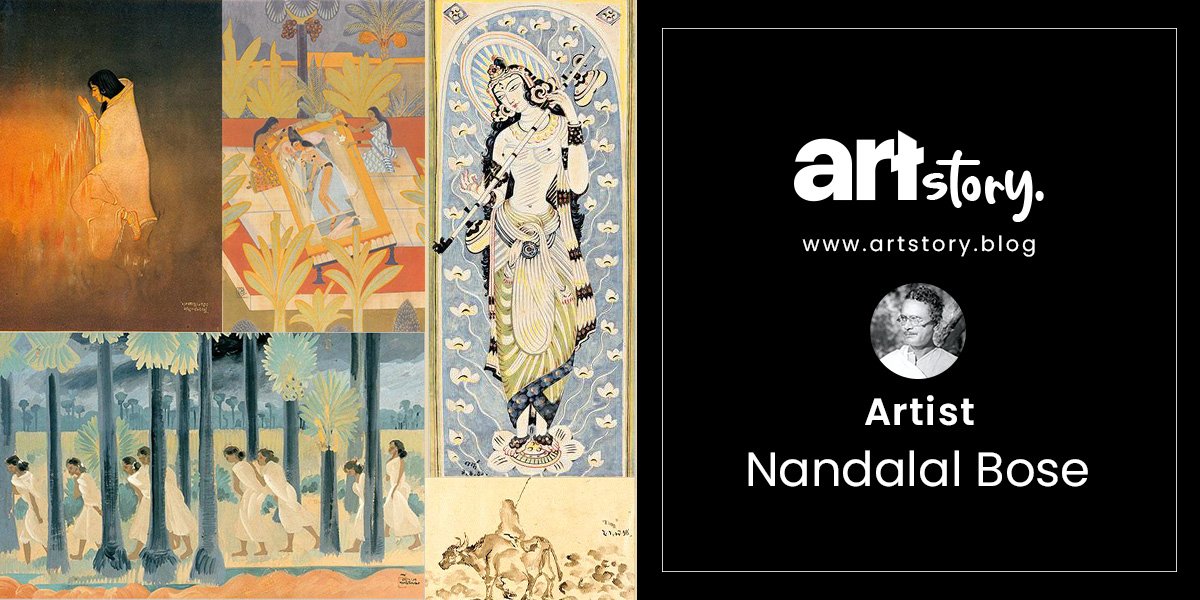
Imagine holding the original, handwritten Constitution of India. As you turn its heavy pages, you don’t just see laws and rules; you see breathtakingly beautiful borders, golden designs, and paintings of Indian history—from the Indus Valley Civilization to Lord Rama, and from Lord Buddha to Mahatma Gandhi.
Who was the master artist chosen for this monumental task of decorating the holy book of the world’s largest democracy?
It was Nandalal Bose.
He is affectionately remembered as the “Master Moshai” (respected teacher) of Indian art. If Abanindranath Tagore planted the seed of the Swadeshi art movement, Nandalal Bose was the massive tree that grew from it, sheltering and inspiring thousands of artists.
Welcome back to this special deep-dive on artstory.blog. Today, we are going to explore the inspiring life of Nandalal Bose, his deep connection with Mahatma Gandhi, his role in India’s greatest art colleges, and the masterpieces that defined his career.
Chapter 1: The Boy Who Loved Clay (Early Life)
Nandalal Bose was born on December 3, 1882, in Kharagpur, in the Munger district of Bihar. His father worked as a manager for the Maharaja of Darbhanga. Even as a little boy, Nandalal was not very interested in textbooks. Instead, he spent hours watching local village craftsmen. He would watch potters shape clay on their wheels, and idol-makers carefully painting the eyes of Goddess Durga before the pujas.
He started copying them, modeling small figures out of sticky mud and drawing on whatever paper he could find.
When he grew older, his family moved to Calcutta (Kolkata) and admitted him to a commerce college. They wanted him to get a “safe, respectable” job. But Nandalal’s heart was just not in it. He kept failing his exams because he secretly spent all his time drawing and painting. Finally, after seeing his absolute passion, his family gave up and allowed him to pursue art.
Chapter 2: Meeting the Guru at the Government College of Art and Craft
In 1905, Nandalal Bose took the biggest step of his life. He walked into the Government College of Art and Craft Calcutta holding some of his sketches, hoping to show them to the legendary Abanindranath Tagore, who was teaching there.
Abanindranath took one look at the young boy’s drawings and instantly recognized his pure, raw talent. He took Nandalal under his wing.
This was the golden period of the “Bengal School of Art.” Under Abanindranath’s guidance, Nandalal learned the soft watercolor wash techniques. But Nandalal went a step further. He traveled across India, deeply studying the ancient murals of the Ajanta Caves, copying them stroke by stroke. He realized that true Indian art must have bold, strong lines and must connect with the common village people, not just the rich people living in cities.
Chapter 3: The Soul of Kala Bhavana, Shantiniketan
Rabindranath Tagore, the great poet, was building a dream university away from the crowded city—a place where students would learn under the open sky, surrounded by nature. This was Shantiniketan.
Rabindranath knew that his university needed an art department that was deeply rooted in Indian culture. He invited Nandalal Bose to take charge.
In 1922, Nandalal became the principal of Kala Bhavana Shantiniketan. This was a historic moment. Nandalal completely changed how art was taught in India. He told his students to step out of closed classrooms. He taught them to look at the trees, the Santhal village women working in the fields, the local festivals, and the animals.
Because of Nandalal Bose, Kala Bhavana became the most important, spiritually rich fine arts college in the country. He became the beloved “Master Moshai,” producing legendary students like Ramkinkar Baij and Benode Behari Mukherjee.
Chapter 4: Mahatma Gandhi’s Favorite Artist
When Mahatma Gandhi was leading the freedom struggle, he noticed Nandalal Bose’s work. Gandhi wanted an artist who could speak to the poorest farmers of India through pictures. He found his man in Nandalal.
In 1930, when Gandhi started the famous Dandi March (Salt Satyagraha), Nandalal created a simple black-and-white print of Gandhi walking with his wooden staff. This single image became so powerful that it became the ultimate symbol of the Indian freedom movement worldwide.
Later, Gandhi gave Nandalal a massive project. For the 1938 Indian National Congress session in Haripura, Gandhi asked Nandalal to decorate the entire pavilion. But Gandhi had a strict condition: the art must be made using only local, cheap village materials. Nandalal happily agreed and created the legendary “Haripura Posters” using local earth colors on handmade paper.
Chapter 5: A Deep Dive into His Masterpieces
Nandalal Bose did not stick to just one style. He painted Hindu mythology, common village life, and historical events. Let’s look at some of his greatest works:
1. Bapuji (The Dandi March) – 1930
- The Story: This is the most famous portrait of Mahatma Gandhi ever made. Created to mark the Salt March of 1930, it captured the exact spirit of the peaceful rebellion.
- Detailed Breakdown: This is not a painting, but a “linocut” (a type of printmaking where the image is carved into a block, inked, and pressed onto paper). It is entirely black and white. With just a few bold, rough, thick white lines against a black background, Nandalal captured Gandhi’s determination, his forward movement, and his unstoppable willpower.
- Why it is great: It proves that an artist doesn’t need millions of colors to create a masterpiece. Sometimes, strong black-and-white lines can shake an entire British empire.
2. Sati – 1907
- The Story: Painted during his early days at the Government College of Art and Craft, this portrays the ancient, tragic practice of Sati, where a widow stepped into her husband’s funeral pyre.
- Detailed Breakdown: Painted using the soft Bengal School wash technique, the painting has an eerie, haunting glow. The woman is not showing panic or fear. She sits with her hands folded in prayer, completely calm, while the bright orange and red flames slowly rise to surround her.
- Why it is great: Japanese art critics were completely mesmerized by this painting when they saw it. It captures absolute devotion and the ultimate sacrifice, turning a horrifying moment into a deeply spiritual visual.
3. Shiva Drinking the World Poison (Halāhala)
- The Story: From the Puranas, this shows the moment during the churning of the ocean (Samudra Manthan) when a deadly poison emerged. To save the universe, Lord Shiva drank the poison, holding it in his throat, which turned blue (giving him the name Neelkanth).
- Detailed Breakdown: Notice the strong, confident lines that define Shiva’s body. The colors are very earthly and muted. His expression is completely peaceful despite swallowing fire.
- Why it is great: Nandalal loved painting Lord Shiva. For him, Shiva was the ultimate symbol of a yogi—calm, detached, and sacrificing himself for the good of the world, much like what the freedom fighters were doing for India.
4. The Haripura Posters (e.g., The Bull Handler / The Musician)
- The Story: As requested by Mahatma Gandhi, these were posters made to decorate the Congress gathering in Haripura in 1938.
- Detailed Breakdown: Nandalal painted over 400 posters! He painted ordinary people: a cobbler, a tailor, a woman spinning yarn, a farmer pulling a bull, and a musician playing a drum. He used bright, flat, raw colors (like vibrant yellow, red, and blue) and very fast, sweeping brush strokes.
- Why it is great: He proved that “fine art” is not just for gods and kings. By painting ordinary working-class Indians, he told the world that the true strength and beauty of India lived in its villages.
5. Parthasarathi – 1912
- The Story: This is a scene from the Mahabharata, right before the Kurukshetra war, where Lord Krishna is driving the chariot for the warrior Arjuna.
- Detailed Breakdown: What is unique here is the focus. Arjuna is barely visible; the entire focus is on Lord Krishna holding the reins of the horses. The painting has a very calm, divine atmosphere, painted with the delicate Japanese wash technique. The majestic white horses look powerful but perfectly controlled by the divine charioteer.
- Why it is great: It perfectly captures the message of the Bhagavad Gita—finding peace and divine guidance right in the middle of a chaotic battlefield.
Chapter 6: Decorating the Constitution of India
When India finally gained independence, Jawaharlal Nehru gave Nandalal Bose the most honorable task any artist could ask for. He was asked to design the original manuscript of the Constitution of India.
Along with his students from Kala Bhavana, Shantiniketan, Nandalal spent years on this project. For every major part of the Constitution, he painted a piece of Indian history. He painted the ancient seal of the Indus Valley bull, Lord Rama returning to Ayodhya, Emperor Ashoka spreading Buddhism, and Netaji Subhas Chandra Bose marching.
He didn’t just decorate a legal book; he painted the entire 5,000-year-old soul of India into its modern law.
Conclusion
Nandalal Bose passed away on April 16, 1966.
If Raja Ravi Varma gave Indian gods their faces, and Abanindranath Tagore gave Indian art its soul, Nandalal Bose gave Indian art its backbone.
He stepped out of the royal courts and elite drawing rooms, took art to the dusty villages of Haripura, the open trees of Shantiniketan, and finally, directly into the pages of our Constitution. He was a true patriot who fought for India’s freedom not with a gun, but with a paintbrush.